How many charities have accessed funding for digital costs and projects over the last year?
The number of charities accessing digital funding from grantmaking trusts and foundations has dropped to 17% from 30% last year.
The number of charities that received funding to cover digital costs, whether from grants, sponsorship, contracts, donations or social investments, has fallen dramatically this year.
- 17% have received funding from grantmaking trusts and foundations, compared to 30% in 2025. Charities led by and for specific marginalised groups have similar levels of access to funding, rising to 30% of disabled and deaf-led charities (this could link to our survey outreach, via funders working in this area).
- 9% have received funding from other sources, similar to last year, rising to 15% of large charities.
- 69% have not received any digital funding, up from 60% last year. This rises to 73% of small charities, but half (53%) of large charities.
The same results are true for charities that are advancing and advanced with digital (22%), although this is higher than charities that are at an early stage with digital adoption (15%).
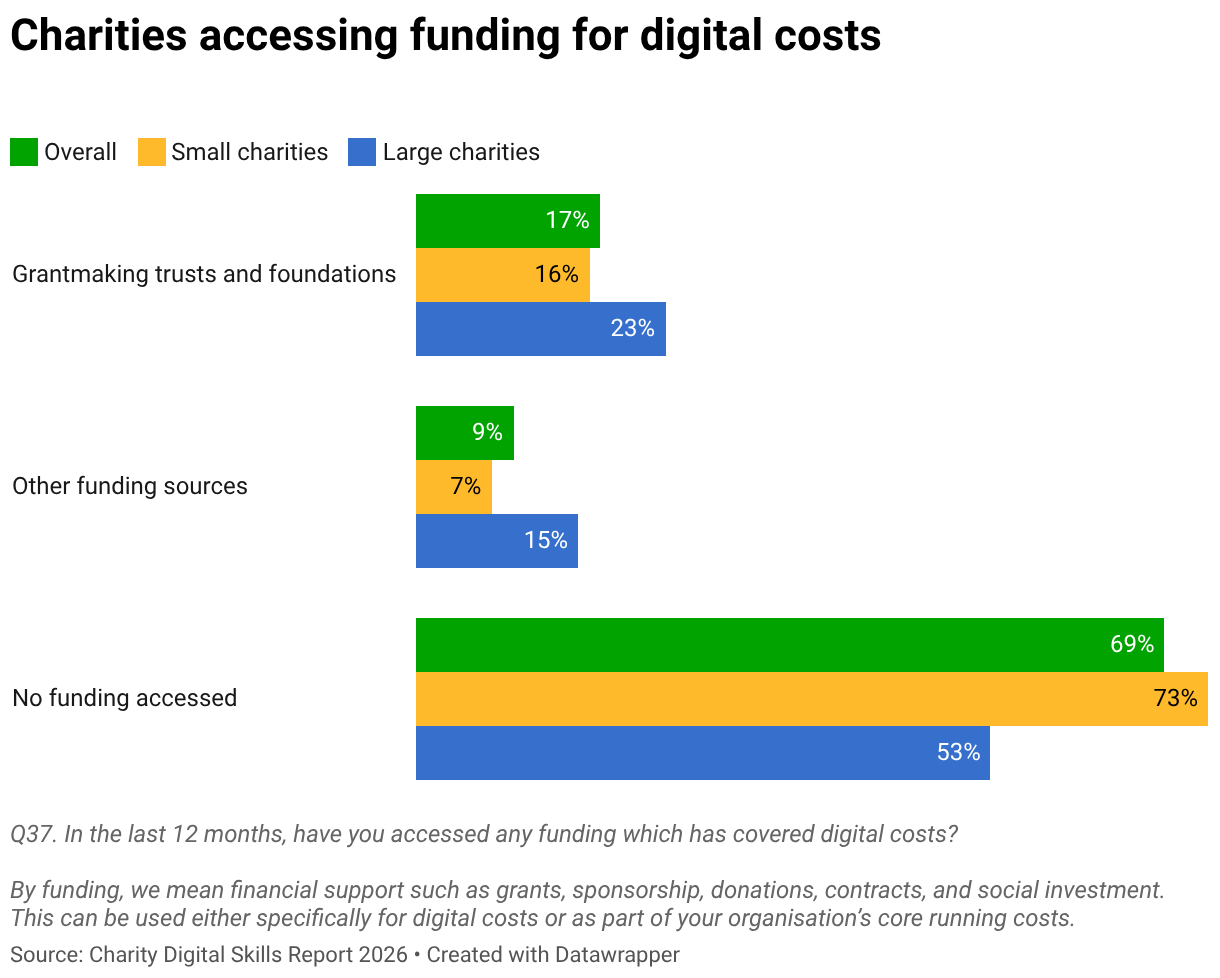
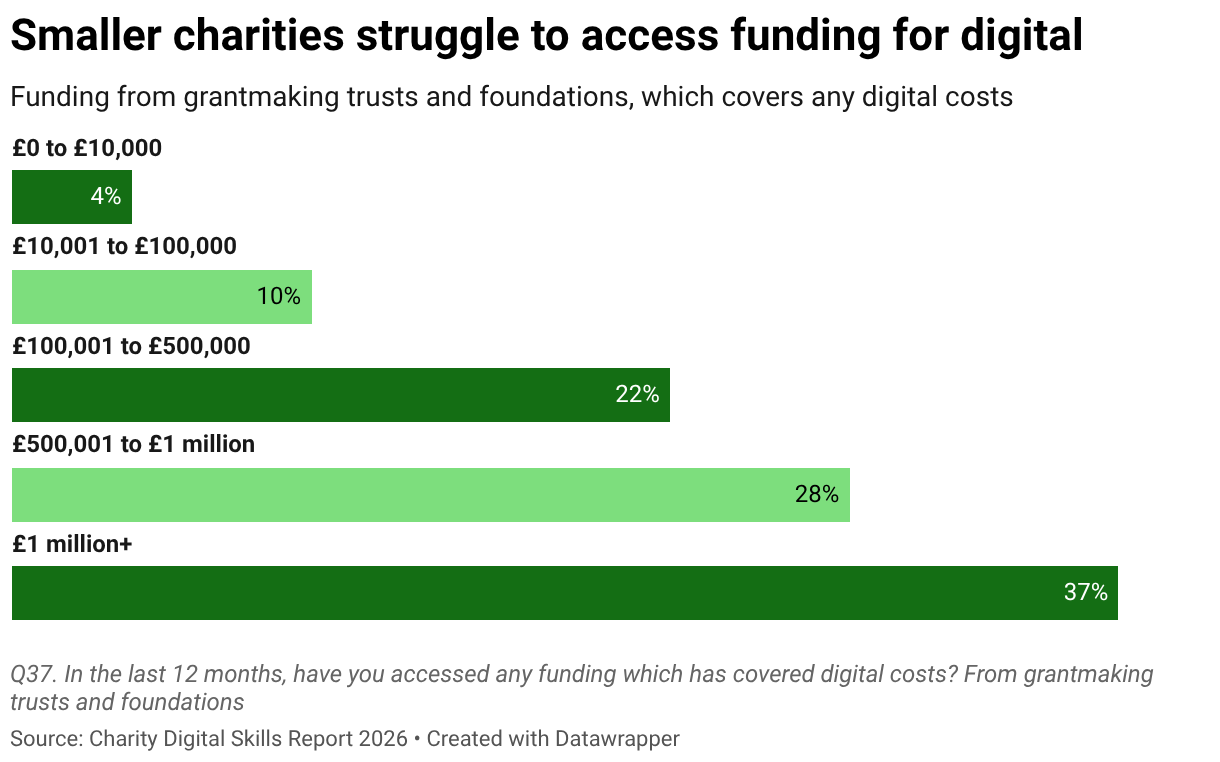
Crucially, small charities are struggling most to access funding for digital costs from grantmaking trusts and foundations (16% of small charities accessed funding, compared to 23% of large charities). We can also see that the smallest charities are least likely to access digital funding from grantmaking trusts and foundations:
- 4% of those with an income of under £10,000 accessed digital funding.
- 10% of those with an income between £10,000 to £100,000 accessed digital funding.
- 22% of those with an income between £100,000 and £500,000 accessed funding.
- 28% of those with an income between £500,000 and £1m accessed digital funding.
Overall, we are surprised to see that access to digital funding is so low this year. Our barriers question below highlights that this is a multi-faceted problem, linked to financial pressures and the funding needs charities have, a lack of funding to apply for, and funders only supporting limited core costs. In our ‘priorities’ section of the report, we noted that 38% of charities want to secure funding for digital costs and projects in the year ahead. Crucially, this rises to 50% of disabled and deaf-led charities, 56% of neurodivergent-led charities and 62% of global majority-led charities.
What do charities most need digital funding for in order to progress with digital?
This year’s most urgent needs show how charities’ focus is now on skilling, infrastructure, AI and digital channels. Last year higher numbers of charities wanted funding for organisational development, strategy and digital roles (whether core staff or freelancers).
The top 5 areas charities have the greatest need for funding are:
- Training staff, volunteers, leaders and boards is the top funding need for 44% of both small and large charities, reflecting a common theme in this year’s report (down slightly from 50% last year).
- Software and licences are also a key funding need for just over a third of charities (34%), both small and large, similar to last year.
- Developing our use of AI has risen to 34% this year, from 23% last year. This is key for 43% of large charities, as well as 31% of small charities. This is also a key funding need for charities led by and for disabled and deaf people (60%).
- IT, devices and equipment are a key funding need for 33%, similar to 2025.
- A website, content or brand revamp is a need for 31%.

Funding needs for different types of charities
More large charities need funding for services, including to develop new digital and AI services (34%), to improve existing digital services (28%) and to deliver digital services (24%). Combining these responses, 51% of large charities need funding for digital service design or delivery. This compares to 36% of small charities.
The top funding needs for large charities are:
- Developing our use of AI (45%).
- Training staff, volunteers, leaders or boards (45%).
- Software and licences (37%).
The top funding needs for small charities are:
- Training staff, volunteers, leaders or board (44%).
- Software and licences (34%).
- IT, devices and equipment (33%).
- Developing our use of AI (31%).
Demand for some types of funding is higher amongst charities led by and for specific marginalised groups. This includes:
- Funding to develop use of AI for 60% of disabled and deaf-led charities and 40% of neurodivergent-led charities (vs 31% of other small charities).
- IT, devices and equipment are needed by 57% of neurodivergent-led charities and 49% of deaf and disabled-led charities (vs 33% of other small charities).
- Providing digital inclusion support: A third (36%) of charities led by and for neurodivergent people and 43% of charities led by and for disabled and deaf people need funding for digital inclusion services (vs only 14% of other charities), linked to 40% providing this support informally.
Securing funding for digital costs and projects generally is also a higher priority for 62% of global majority-led charities and 56% of neurodivergent-led charities, as well as 50% of disabled and deaf-led charities (vs 38% of charities overall).
What barriers do charities face when looking for or accessing digital funding?
This year we updated our barriers question to cover a wider range of issues raised last year by charities. However, we have still not uncovered one single challenge that prevents a significant proportion of charities from accessing digital funding. Given the low level of funding accessed this year, the barriers charities faced are multi-faceted.
- Overall, the biggest barrier charities face is that they have not considered or tried to seek funding for digital costs (29%). This falls to 19% of large charities.
- The open comments give clarity here. This is not an issue of not needing digital funding. Instead, they highlight that charities are simply not in a position to prioritise fundraising for digital projects, or to include costs in their applications. This links to financial pressures, as well as limited funding availability generally. It is clear that charities do not believe it is possible to access the digital funding they need, so they focus on other priorities.
“There is not enough time to seek digital funding when we have to fund our programme and core costs. We submitted an average of over 2.5 bids per week last year just to do this.”
“I was not aware there were grants available for it or what the funding would cover. We had to downgrade our website to make it more affordable.”
“Funding is all very well to cover year 1 costs, it’s the subsequent years that we can’t afford. So we don’t bother.”
“Mostly we’ve tried fundraising for equipment – but most funders are not interested in this. Not had any success. I have to admit I’ve not considered training costs, software or other aspects.”
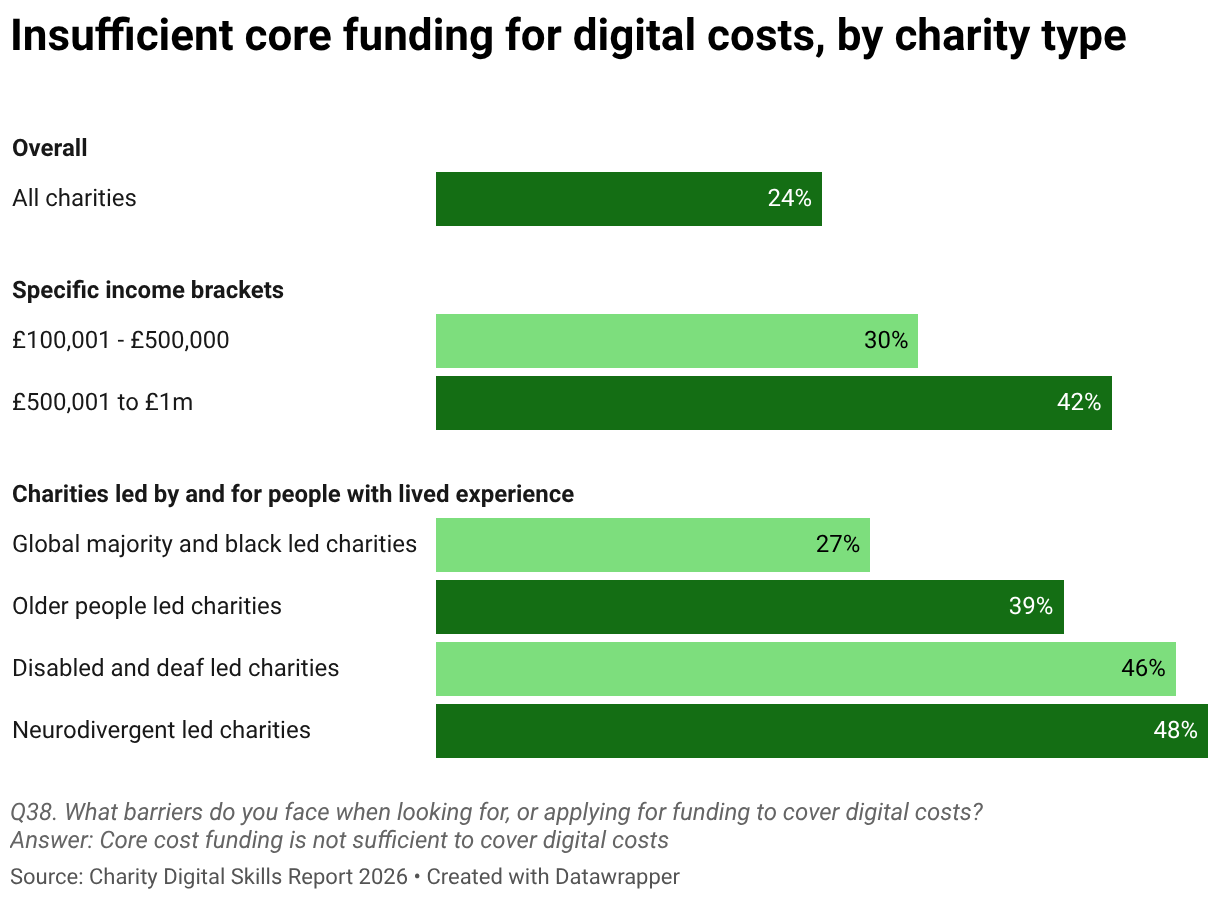
- The second-biggest barrier charities face (24%) is that core cost funding is not sufficient to cover digital costs. Insufficient core cost funding is the biggest barrier faced, and especially significant to:
- Charities with an income between £500,000 to £1million (42%).
- Charities that have successfully accessed digital funding (35%).
- Disabled and deaf-led charities (46%), noting that a higher proportion have accessed some digital funding (30%, vs 17% overall).
- Neurodivergent-led charities (48%).
- Charities with an income between £500,000 to £1million (42%).
In the current financial climate, charities are stuck and unable to move forward with digital. This is not due to a lack of need or demand for digital cost funding. Instead, other pressures are taking priority. It is vital that funders take the lead here. This could be by supporting charities to access skills training, support or external guidance (for organisational development). Funders could also make a significant difference to charities by increasing core cost flexibility and amounts to incorporate the need to pay for the nuts and bolts that keep charities running (software, devices).